Keyboard Maestro IconKeyboard Maestro

Conduct your Mac Like a Pro!

Custom Keyboard Automation Software - Increase Business Productivity with Mac Macros using Keyboard Maestro

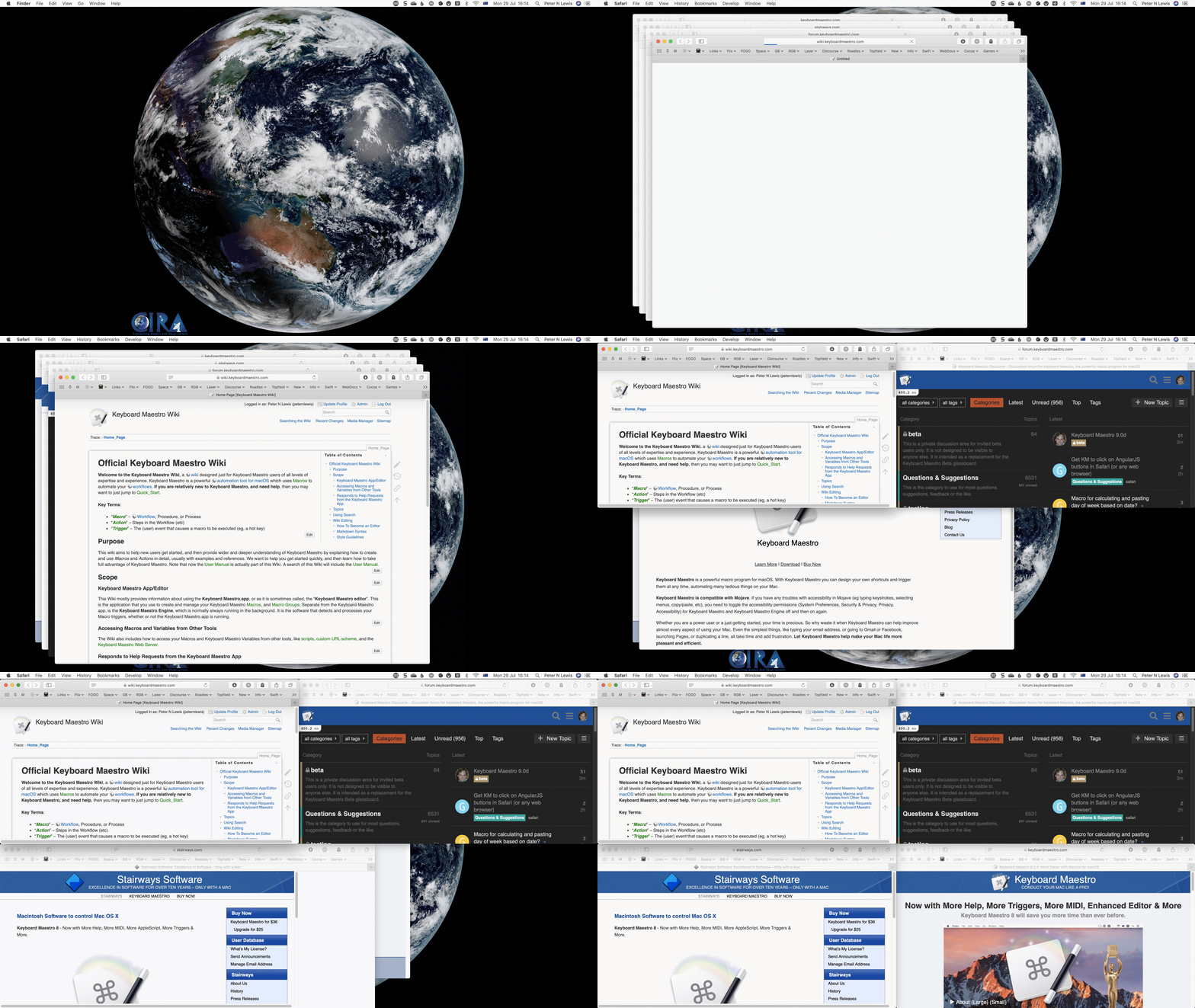
Keyboard Maestro is a powerful macro program for Mac OS X (including Tiger and Leopard) which has received glowing reviews. Keyboard Maestro will take your Macintosh experience to a new level in “Ease of Use”. With Keyboard Maestro you can design a custom action sequence with your own shortcuts and activate them at any time, you can navigate through running applications and open windows with Program Switcher, and you can work with an unlimited number of clipboards - all by pressing simple keystrokes.

With the release of Keyboard Maestro 3 we have added recording, disabling of individual macros and groups, Try Now button, PC Switcher Pack, built in web server, and much more.

You can view the full feature list, read the documentation, see what’s new in 3.0.1, read what others are saying, look at some example macros, or download Keyboard Maestro.

Take the Keyboard Maestro Tour to see the power of Keyboard Maestro in action or watch some examples and tutorials.

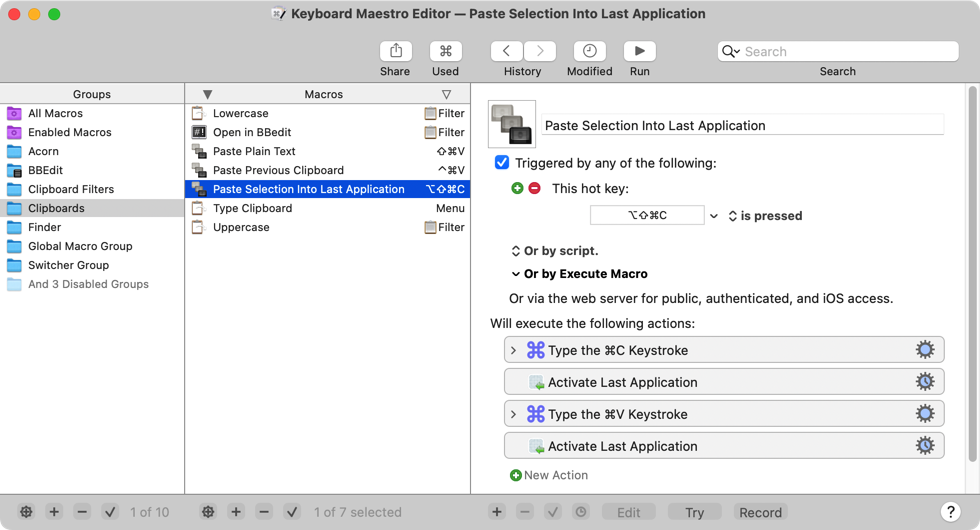
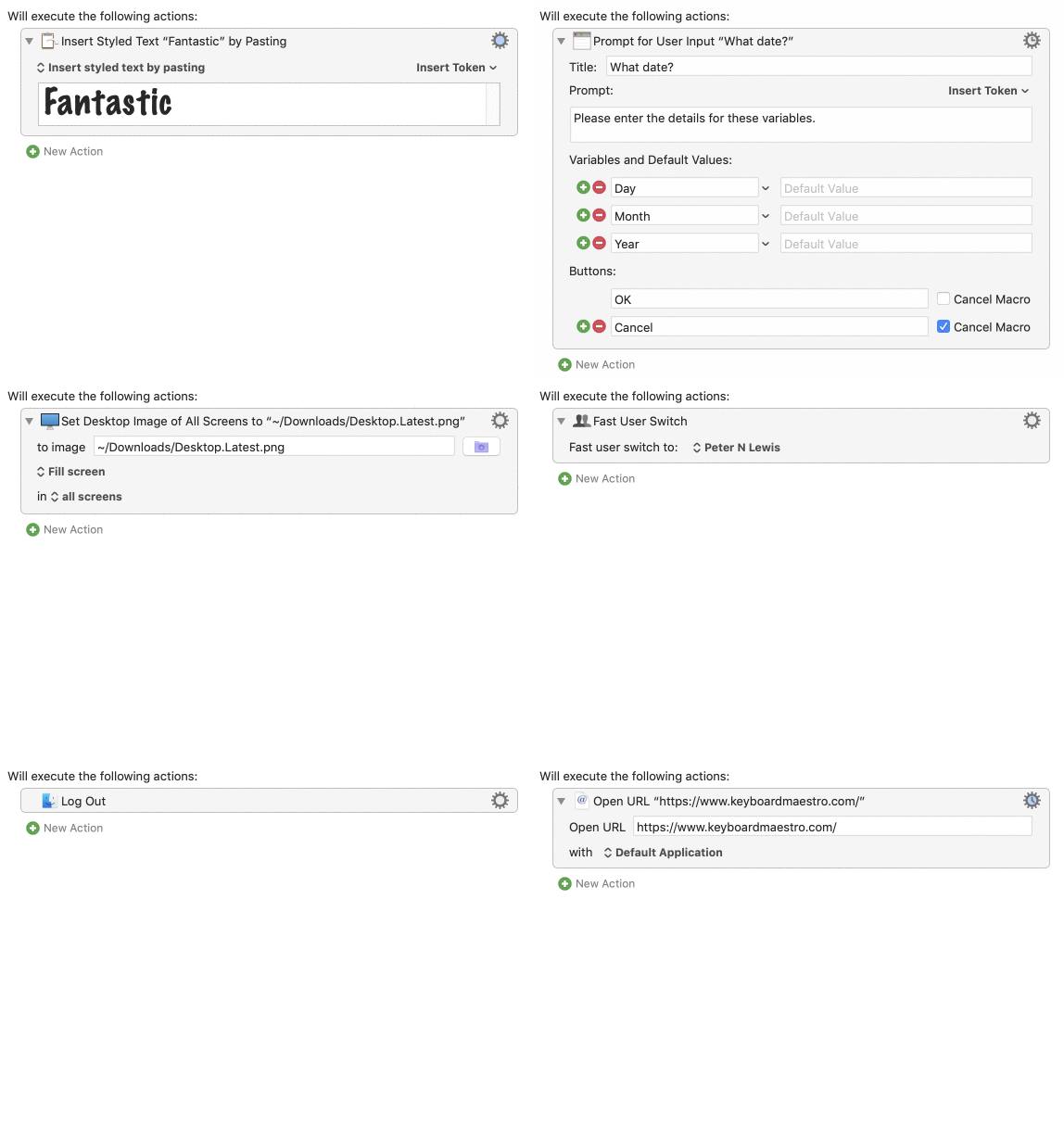
Primarily Keyboard Maestro is a macro program. A macro consists of a sequence of actions and a set of triggers. When any of the triggers occur, Keyboard Maestro executes the actions. Keyboard Maestro provides a large range of actions that allow you to control applications, type keys, click the mouse, resize windows, control iTunes, execute scripts and much more. Keyboard Maestro also provides a range of triggers, the most common being the Hot Key trigger, but you can also trigger a macro when an application launches or quits, at a specific time, from a floating macro palette, via the in-built web server, or using AppleScript. Keyboard Maestro also provides access to a powerful window switcher, program switcher, and to multiple named clipboards. Keyboard Maestro can automate and streamline a wide variety of tasks.
A macro consists of a sequence of actions and a set of triggers. When any of the triggers occur, Keyboard Maestro executes the actions. To create a macro, launch Keyboard Maestro and click the plus button in the macros pane. In the macro editor, name the macro and add a trigger. Normally you will use a Hot Key trigger, in this case we will use F6. In this example, we will simply open a file. Select the file and save the macro. We can now quit Keyboard Maestro, and the Keyboard Maestro Engine will continue to run, so we can open the document any time simply by pressing F6. For more macro ideas, check out the macro examples in the documentation and keep an eye out for any repetitive actions you take.
Primarily Keyboard Maestro is a macro program. A macro consists of a sequence of actions and a set of triggers. Keyboard Maestro includes a faceless background engine so you only need to launch Keyboard Maestro to make changes. When any of the triggers occur, the Keyboard Maestro Engine executes the actions, even if Keyboard Maestro is not running. So the first thing you should do is ensure the engine is launched when you login - switch to the Preferences Pane and enable the checkbox. Many of Keyboard Maestro’s facilities require access for assistive devices, so you may also want to check that it is enabled in the Universal Access system preference. You can now quit Keyboard Maestro and the engine will continue to run, so you can execute macros such as the one we setup earlier that opens a document when we press F6. Over the next few days, whenever you find yourself repeating an action, consider launching Keyboard Maestro and creating a macro to automate the task.
In this tutorial, we will show you how to create a complex macro that will allow you to save clippings to a text file. First, launch TextEdit and create a new empty file and save it. Next, launch Keyboard Maestro and create and name a new macro. Then add a hot key trigger. Now add the actions. First, Copy to a named clipboard. We will create a new clipboard named “Clipping” Open the Clippings file. Insert a header for each entry, including the current date. Paste in the named clipboard. Record the keystrokes for Return, Return, Save, Close. Delete the extraneous recorded actions. And finally switch back to the last application. Save the macro, and then try it out in the Finder. Adding the current selection to your Clippings file is now as easy as pressing F2.
In this example we will create a macro to simulate workspaces in TextEdit. The macro will setup TextEdit with four documents carefully positioned on the screen. First we launch Keyboard Maestro and create and name a new macro. Then we configure a macro palette trigger. We drag the four documents in to create actions opening each one. Since we need them open, we use the Try Now button to open all four documents. Next we ask Keyboard Maestro to record our actions, and reposition the windows as desired. We could create the actions to move and resize the window manually, but it is easier to let Keyboard Maestro record the actions. To ensure the macro will be robust against changes to the environment, we delete any extraneous actions. Next we move the recorded reposition actions immediately after each Open document action. We will test the actions by closing the documents and then clicking the Try Now button. The windows appear perfectly as if by magic, so we save the macro. Notice that the Macro Palette immediately appears. To open and position our documents is now a single click.
In this example we are going to use Keyboard Maestro to make an HTML menu from an existing color table. First we drag the color table in to our HTML document, and then position the cursor at the start of the first entry. Next we activate the Record Quick Macro action and using copy and paste and some typing we convert the first color entry into an HTML menu option. After the conversion, we make sure we leave the cursor at the start of the next entry. Then we tell Keyboard Maestro we have finished, and proceed to execute the recorded macro with a single keystroke for each remaining color entry. All that is left to do is clean up and save.

With a little imagination (see some example macros to get you started) and a few actions strung together you could increase business productivity by automating any of the repetitive day-to-day tasks that currently waste your time. Before long, you will wonder how you ever lived without it. If you’re considering QuicKeys, make sure you try out Keyboard Maestro.

Keyboard Maestro is exclusively available for sale online from Kagi. Distributed via electronic download you can be up and running with Keyboard Maestro in a matter of minutes. Plus we offer a full 30 day refund if it does not work to your satisfaction. It is quick, easy and risk-free to download or purchase Keyboard Maestro today!

Download - 5 MB

Buy Now

User Database

Information

Assistance

Search